Journal / Historical vision essay
Evolution of Humanity to Physical AI - and Powering Up the Next Generation
An early vision for reusable software across physical devices, told through the history of tools and operating systems.
Author: Shubham Kumar Gupta · Founder, Chakra47 Research Citations: Sania Gurung · Technical Co-Founder, Chakra47
I want to tell you a story that didn't start in a boardroom, a lab, or a Silicon Valley garage. It started , impossibly long ago , around a fire. A small, trembling flame that a human ancestor coaxed out of stone, changing everything that would ever come after. That moment wasn't just about warmth or food. It was the first time a human being used a tool to extend their own capability beyond biology. That instinct has never stopped. And we at Chakra47 believe we're living through its most consequential chapter yet.
"The human brain is not the end of evolution. It is the beginning of a new kind of it." , Paraphrased from Carl Sagan, Cosmos, 1980
Chapter 01 , The Brain That Refused to Stop
300,000 BCE: The Biological Miracle
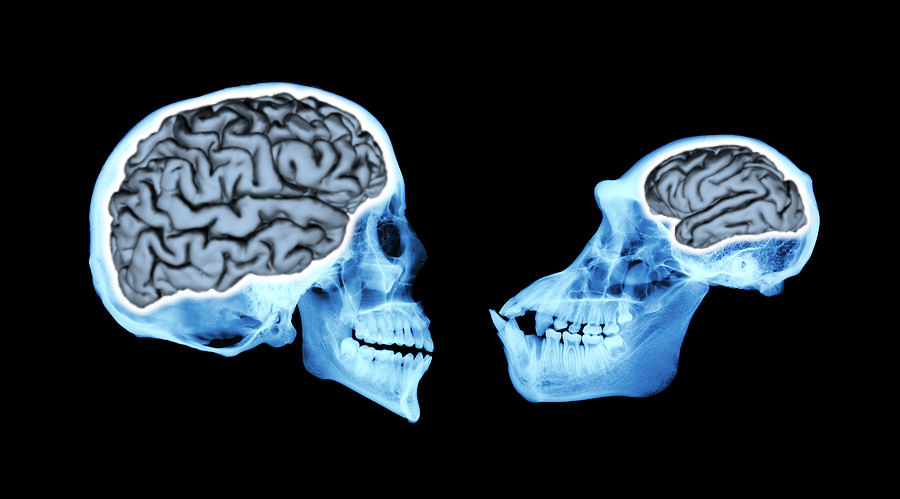
The human brain , roughly 1.4 kg of electrochemical machinery , is, by any measure, the most complex structure in the known universe. But what made it remarkable wasn't just its size. It was plasticity: the ability to rewire itself based on experience, to learn, to adapt, and to imagine things that don't yet exist.
📚 Research Note (Sania Gurung): Deacon, T.W. (1997). The Symbolic Species: The Co-Evolution of Language and the Brain. W.W. Norton. , Documents how symbolic cognition fundamentally restructured human neural architecture, enabling recursive thought and tool use far beyond any other species.
Early Homo sapiens didn't just react to the world. They modeled it. They asked: what if I put this rock here? That capacity for mental simulation , running hypothetical futures in your head before committing to action , is the root of every technology that has ever existed, including what we're building at Chakra47.
~400,000 BCE: Fire , The First Operating System
Fire wasn't just energy. It was infrastructure. It restructured human society: communities gathered around it, food became safer and more calorically dense (which ironically fed even more brain growth), nights became productive, predators were kept at bay. Fire was the first time humanity deployed a persistent environmental process to serve human goals autonomously , burn fuel, produce heat, repeat.
📚 Research Note (Sania Gurung): Wrangham, R. (2009). Catching Fire: How Cooking Made Us Human. Basic Books. , Presents the hypothesis that cooked food drove the dramatic increase in brain size in the genus Homo, linking external tool use directly to biological cognitive advancement.
"Cooking is the signature feature of the human diet. It defines us." , Richard Wrangham, Harvard University
Chapter 02 , The Wheel, the Press, and the Machine
~3500 BCE: The Wheel
The wheel didn't just move things. It moved civilisation's economic metabolism. It transformed trade routes, enabled irrigation, powered early industry. More importantly, it represented a principle that every great technology since has followed: take something the human body does badly , long-distance carrying , and externalise it into a durable mechanism. That principle is our North Star at Chakra47.
| Era | Milestone | What Was Externalised |
|---|---|---|
| ~3500 BCE | The Wheel | Movement and physical transport |
| ~1440 CE | Gutenberg's Press | Knowledge replication |
| 1760–1840 | Industrial Revolution | Physical labour and muscle |
| 1936 | Turing's Universal Machine | Cognition (in theory) |
| 2008 | Android | Intelligence across devices |
| 2025 onward | Chakra47 vision | Reusable capabilities for physical systems |
Each of these moments followed the same arc: humans identified a bottleneck in what their bodies or minds could do, built a mechanism to offload that bottleneck, and then , freed from it , found entirely new bottlenecks to work on. That recursive loop is human progress.
Chapter 03 , The First Computer, the First Laptop , and the Birth of the Digital Brain
1945–1975: Computation Finds a Body
ENIAC , the first general-purpose electronic computer, unveiled in 1945 , occupied 1,800 square feet and weighed 30 tonnes. It could perform 5,000 additions per second. Remarkable for its time. Laughable by today's standards. But the idea it embodied was revolutionary: a machine that could be reprogrammed to solve any mathematical problem, not just one specific task. That flexibility , that generality , is the seed of everything that matters in computing.
📚 Research Note (Sania Gurung): Ceruzzi, P.E. (2003). A History of Modern Computing. MIT Press. , Comprehensive account of how programmable digital computers evolved from wartime calculation machines to commercial platforms, with key attention to the role of software abstraction in democratising access.

1981–1995: The Laptop Changes Everything
When IBM released the first mass-market portable computer in 1981 , and Apple followed with successive iterations through the 80s and 90s , something profound shifted. Computing was no longer a room you walked into. It was a device you carried. The brain moved closer to the person. Closer to the problem. The friction between human intention and computational power dropped by an order of magnitude.
This is a pattern we care deeply about at Chakra47. Every time the distance between human intent and computing power shrinks, an explosion of new productivity follows. Mainframe → desktop → laptop → smartphone. Each compression unlocked new categories of human activity that simply weren't possible before.
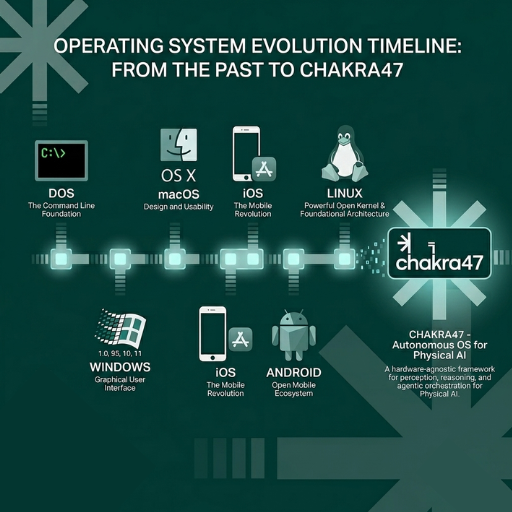
Chapter 04 , Android, iOS, Windows, Linux , The Era of the Universal OS
The Operating System as Infrastructure
Here's a question that rarely gets asked: what exactly is an operating system? Technically it's a software layer that manages hardware resources. But functionally, it is something far grander. An OS is the grammar of a machine , the shared language through which all software speaks to all hardware, regardless of who made either of them.
📚 Research Note (Sania Gurung): Tanenbaum, A.S. & Bos, H. (2014). Modern Operating Systems (4th ed.). Pearson. , Foundational textbook establishing how OS abstraction layers enable hardware-agnostic software development, creating platform economies.
Android , The Democratic Brain
When Google released Android as an open platform in 2008, the stated goal was simple: get the internet into everyone's hands. What actually happened was more significant. Android became the operating system for billions of devices , phones, tablets, smart TVs, car dashboards, refrigerators. Today it runs on over 3.9 billion active devices worldwide. It became the cognitive layer of the physical world's smart objects.
📚 Research Note (Sania Gurung): IDC Worldwide Quarterly Mobile Phone Tracker (2024). Reports Android's global smartphone OS market share consistently above 71%, with total ecosystem devices , including IoT and embedded , estimated beyond 3.9 billion. Source: idc.com
iOS , The Premium Nervous System
Apple took a different philosophy. Where Android was open and democratic, iOS was curated and vertical. Apple controlled the silicon, the OS, the app store, the hardware design , the entire stack. The result was a device ecosystem of extraordinary coherence: every iPhone, iPad, and Apple Watch speaks the same language, maintains the same security model, delivers the same experience. iOS didn't just run on devices. It defined a quality of experience.
Windows & Linux , The Foundation of Human Work
Windows gave the world a graphical interface that made computing legible to non-engineers. Billions of people learned to think in folders, files, and applications , an entirely new cognitive vocabulary created by software. Linux, meanwhile, became the invisible backbone of the internet: Linux powers a substantial part of modern computing infrastructure. It powers Android, it powers most cloud infrastructure, it powers the supercomputers that train the AI models reshaping civilisation today.
📚 Research Note (Sania Gurung): W3Techs Web Technology Surveys. Web-server operating-system estimates depend on the survey scope and detectable technology. w3techs.com/technologies/details/os-linux
"Every OS ever built answered the same question: how do we make it easier for human intention to command machine capability? That question has one more chapter left , and it's physical." , Shubham Kumar Gupta, Chakra47
Chapter 05 , The Gap Nobody Talks About
Software Ate the World. Physical Reality Didn't Move.
Marc Andreessen famously wrote in 2011 that "software is eating the world." He was right , for digital products. But look around you. The physical world , warehouses, factories, delivery vehicles, construction sites, agricultural machinery , is still largely dumb. It runs on human muscle, manual coordination, and process documents written a decade ago.
We've given software incredible brains: large language models that can reason, generate, and plan across virtually any domain. But these brains have no body. They can't pick up a package, navigate a road, inspect a machine part, or coordinate a logistics fleet in real time. The bottleneck has shifted. The next compression , the one that will unlock the next explosion of human productivity , is bridging AI cognition to physical systems.
📚 Research Note (Sania Gurung): Gupta, S. et al. (2024). Symbiote-X: A Neuro-Symbolic Governance Framework for Autonomous Physical Systems. Internal whitepaper, Chakra47 / Stakrid Logistics Pvt Ltd. , Introduces the four-layer architecture (perception → symbolic reasoning → blockchain audit → orchestration) for verifiable autonomous physical AI.
What the Research Says
A 2023 McKinsey report examines the potential economic value of generative AI across business functions. That analysis is broader than physical automation and does not establish a market estimate for Chakra47. Our specific interest is in the software needed to connect device data, compatible capabilities, and controlled physical actions.
📚 Research Note (Sania Gurung): McKinsey Global Institute (2023). The Economic Potential of Generative AI. , An analysis of potential value from generative AI across business functions; not a forecast specifically for physical-device platforms. mckinsey.com/mgi

Chapter 06 , Chakra47: The Brain and OS for the Physical World
Why We Exist
We started Chakra47 because we kept running into the same wall. We were building autonomous systems , last-mile delivery, logistics coordination, AI-powered rider management , and every time we needed a physical system to do something intelligent, we had to build the entire stack from scratch. Perception, reasoning, governance, coordination. Over and over again. We wanted a shared platform that could reduce repeated integration work across physical systems.
So we decided to build it ourselves.
Chakra47 is working toward a platform for connecting physical devices, managing them, and installing compatible capabilities as apps. The long-term ambition spans different kinds of hardware; support and autonomy must be established for each integration.
What This Actually Means
Think about what Android did for mobile: common interfaces helped developers build applications for a range of supported devices. Hardware requirements and compatibility still mattered. A similar reduction in repeated integration work is the ambition for Chakra47.
The aim is to make capabilities reusable through shared interfaces, while retaining the adapters, hardware-specific controls, resource requirements, and validation each device needs. Connecting a device does not automatically make it autonomous.
📚 Research Note (Sania Gurung): Russell, S. & Norvig, P. (2020). Artificial Intelligence: A Modern Approach (4th ed.). Pearson. , The standard reference on agent architectures and autonomous decision systems, establishing the theoretical basis for sensor-actuator loops in physical AI environments.
The Time Compression
Reducing repeated integration work is a central goal for Chakra47. We have not published a benchmark establishing a particular reduction in development time; this remains an outcome to validate with supported devices and real projects.
That compression is not magic. It's what every OS has always done , it absorbs the complexity that doesn't need to be reinvented, so the builder can focus on the thing that actually matters: their product.
Chapter 07 , Our Future Is Decided by the Community
The Question Every Builder Has to Answer
Here's the honest thing we keep coming back to. Technology platforms succeed or fail based on a single variable: does the community believe in them enough to build on them? Android succeeded not just because Google made it , but because millions of developers wrote apps for it. Linux thrives not because of any single company , but because engineers around the world trusted it enough to contribute to it.
The question for Chakra47 is the same one that faced every OS before us: will the builders who need a physical AI platform choose to build it themselves from scratch , burning months and years on infrastructure that isn't their core product , or will they choose to build on something, move faster, and spend that time on the thing that actually differentiates them?
📚 Research Note (Sania Gurung): Raymond, E.S. (1999). The Cathedral and the Bazaar. O'Reilly. , The seminal essay on open-source development dynamics, establishing how community-driven platforms outcompete closed proprietary systems in long-run reliability and feature breadth.
We Don't Want to Build It Alone
We believe the right infrastructure, openly shared, makes everyone faster. The public AgenticSwarm repository is one open-source contribution toward this work. The broader Chakra47 platform remains a separate product under development.
If you're building something physical and autonomous , a device, a vehicle, a robot, a drone, an industrial system , and you're currently drowning in infrastructure work that has nothing to do with your core innovation: that's the problem we exist to solve.
The Wheel Keeps Turning
300,000 years ago, a human looked at a rock and imagined fire. 5,000 years ago, a human looked at a log and imagined a wheel. 80 years ago, engineers looked at vacuum tubes and imagined a programmable machine. 17 years ago, a team at Google looked at a mobile landscape locked behind carrier walls and imagined an open platform.
Today, we at Chakra47 look at the physical world , all its warehouses and vehicles and machines and infrastructure , and we see billions of devices waiting for a brain. Waiting for an OS. Waiting for the moment when human intention can, finally, command them at the speed of thought.
That moment is what we're building toward. We hope you'll build it with us.
"The builders who will define the next decade of physical AI are already working. The question is whether they'll spend that time laying pipe , or building cities." , Shubham Kumar Gupta, Chakra47
🌐 Explore the current platform direction at chakra47.com Get in touch if you're building a physical AI product and want to talk architecture, partnership, or collaboration.
Research Citations
Compiled and reviewed by Sania Gurung, Technical Co-Founder, Chakra47
- Deacon, T.W. (1997). The Symbolic Species: The Co-Evolution of Language and the Brain. W.W. Norton & Company.
- Wrangham, R. (2009). Catching Fire: How Cooking Made Us Human. Basic Books.
- Ceruzzi, P.E. (2003). A History of Modern Computing. MIT Press.
- Tanenbaum, A.S. & Bos, H. (2014). Modern Operating Systems (4th ed.). Pearson.
- IDC Worldwide Quarterly Mobile Phone Tracker (2024). Android ecosystem device estimates. idc.com
- W3Techs Web Technology Surveys (2024). Linux web server market share. w3techs.com
- McKinsey Global Institute (2023). The Economic Potential of Generative AI. mckinsey.com/mgi
- Russell, S. & Norvig, P. (2020). Artificial Intelligence: A Modern Approach (4th ed.). Pearson.
- Raymond, E.S. (1999). The Cathedral and the Bazaar. O'Reilly Media.
- Gupta, S. et al. (2024). *Symbiote-X: Neuro-Symbolic Governance for Autonomous Physical Systems.
- Chakra47 / Stakrid Logistics Pvt Ltd. [Internal Whitepaper]